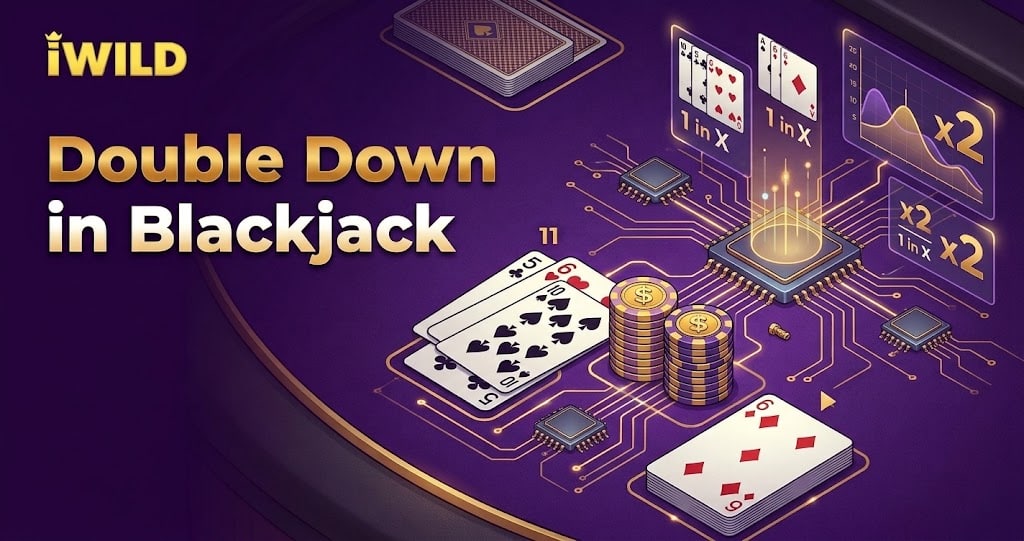
A double down in blackjack is one of the most valuable decisions you can make, but it is also easy to misuse. You are putting twice as much at risk while accepting only one more card, so timing matters.
Whether you are learning at a physical table or exploring blackjack through the iWild Casino site, the same principle applies: double when the numbers justify the extra wager, not simply because your hand looks promising. Below, we cover the rules, hard and soft hands, a quick-reference chart, and two examples showing how the move can win or lose.
Understanding the Double Down Move
Doubling down means adding an amount equal to your original wager after receiving your first two cards. In return, you receive exactly one additional card and must then stand, regardless of your new total.
The trade-off is simple. You give up the option to keep hitting in exchange for putting more money into a situation where doubling has a higher expected value than taking a normal hit.
Once that idea makes sense, the same decision-making becomes easier to recognize across other casino games.
Rules That Apply Before You Double
In standard blackjack, the double option applies to your initial two-card hand and must be selected before taking another card. Once you hit, the opportunity is normally gone. Some variants also limit doubling to particular totals, such as 9, 10, or 11, rather than allowing it on any two cards.
That makes the table rules important. Before using any welcome bonus offers, also check whether blackjack qualifies under the current promotional conditions and confirm the rules of the specific game you intend to play.
Double After Split, In Practice
Double After Split, usually shortened to DAS, means you can double a new two-card hand created after splitting a pair.
Suppose you split two 8s and one of the new hands becomes 11. If DAS is allowed, you may be able to double that hand when basic strategy calls for it. If the table prohibits DAS, that extra option disappears.
The distinction is meaningful. Removing the ability to double after a split worsens the player’s expected return compared with otherwise similar rules.
Knowing When the Odds Are Right
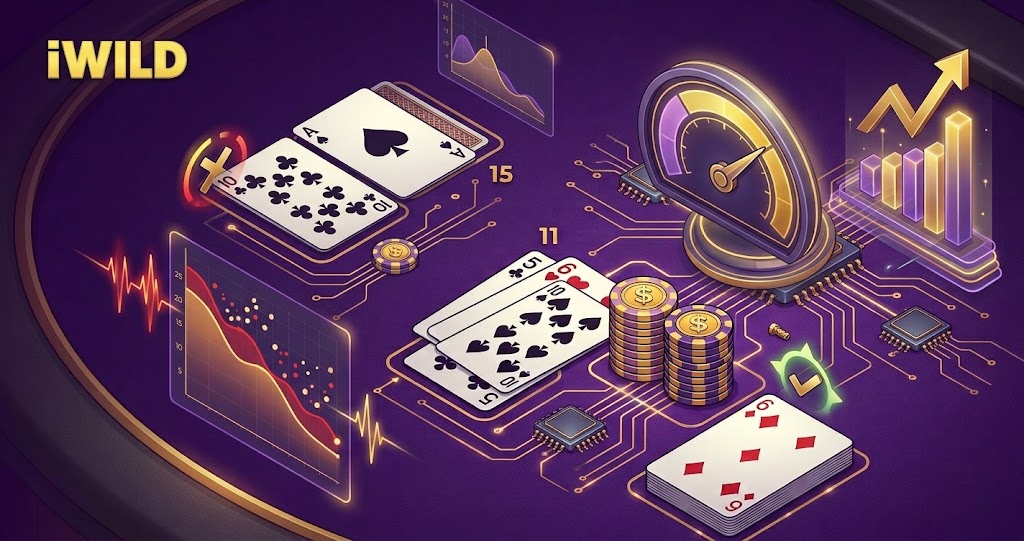
The main doubling opportunities fall into two groups: hard hands and soft hands.
A hard hand either has no Ace or contains an Ace that has to count as 1. A soft hand contains an Ace that can still count as 11. That flexibility changes how aggressively you can play each total.
The recommendations below use a common four-to-eight-deck game where the dealer stands on soft 17. Different blackjack rules can change individual decisions.
Doubling With a Hard Hand
Hard totals of 9, 10, and 11 create the main doubling opportunities.
With hard 9, basic strategy calls for doubling against a dealer 3 through 6. With hard 10, double against 2 through 9. With hard 11, double against 2 through 10 and hit against an Ace under the stand-on-soft-17 rules used here.
Why these hands? Ten-value cards make up 16 of the 52 cards in a standard deck. Drawing one gives hard 9 a total of 19, hard 10 a total of 20, and hard 11 a total of 21.
The dealer’s card matters just as much. A weak dealer upcard gives you a better opportunity to increase your wager, while a 10 or Ace changes the calculation considerably.
Doubling With a Soft Hand
Soft hands give you more flexibility because the Ace can switch from 11 to 1 when necessary. That means taking the single card required by a double cannot bust an ordinary two-card soft hand immediately.
For the same common multi-deck, dealer-stands-on-soft-17 baseline:
- Double soft 13 or 14 against dealer 5 or 6.
- Double soft 15 or 16 against dealer 4 through 6.
- Double soft 17 against dealer 3 through 6.
- Double soft 18 against dealer 3 through 6. Otherwise, stand against 2, 7, or 8 and hit against 9, 10, or Ace.
These plays are easy to overlook because hands such as A-6 or A-7 may not feel especially strong. The advantage comes from combining the Ace’s flexibility with a weak dealer upcard.
A Chart Worth Keeping Close
Here is the doubling logic in one place. It uses the same common four-to-eight-deck, stand-on-soft-17 rules above, so check the specific game before treating it as universal.
| Your Hand Total | Dealer’s Upcard | Action |
| Hard 9 | 3 to 6 | Double |
| Hard 10 | 2 to 9 | Double |
| Hard 11 | 2 to 10 | Double |
| Soft 13 or 14 | 5 to 6 | Double |
| Soft 15 or 16 | 4 to 6 | Double |
| Soft 17 or 18 | 3 to 6 | Double |
If you want a change of pace after learning the table games, the site also has online slot games to explore.
Executing the Move Properly
At a physical blackjack table, place an additional wager equal to your original bet beside the first stack rather than on top of it. Clearly signal to the dealer that you are doubling. Once the dealer accepts the move, one final card is dealt to your hand.
That card ends your turn. You cannot request another hit because the one-card restriction is part of the double-down trade-off. The same principle applies even if your final total is lower than you hoped.
Always follow the dealer’s instructions, since table procedures can vary.
When the Double Isn’t Worth It
Being allowed to double does not mean you should.
Under the baseline strategy used here, a hard 9 should be hit against 2 or 7 through Ace. Hard 10 should be hit against a dealer 10 or Ace, while hard 11 should be hit against Ace.
Hard totals of 12 or above are not normal doubling hands. The chance of drawing a high-value card and busting becomes too important, and the correct choice shifts to hitting or standing based on the dealer’s card.
The same caution applies to soft hands when the dealer shows a stronger upcard. Doubling is about expected value, not simply adding money whenever you cannot bust on the next card.
Playing More Consistently
Start by learning one strategy chart for the exact rules you play rather than relying on memory from several different variants.
Keep enough of your session budget available to cover legitimate doubles and splits. If your regular wager is so large that doubling makes you uncomfortable, your base bet may already be too high.
Most importantly, do not increase your stake because you are trying to recover an earlier loss. A correct double comes from the cards and table rules, not what happened in the previous hand.
Mistakes That Undo Good Strategy
A common mistake is doubling whenever the player’s total is 10 or 11 without checking the dealer’s upcard. A hard 10 against a dealer 10, for example, is a hit under the baseline strategy, not a double.
The opposite mistake is refusing a correct double because the extra wager feels uncomfortable. That avoids the larger stake, but it also gives up some expected value when doubling is mathematically preferred.
Another error is using a memorized rule from one variant at a table with different doubling or soft-17 rules.
Two Genuine Outcomes, Explained
Knowing your blackjack card values makes the logic much easier to follow.
Example 1: the double wins.
You wager $10 and receive a 6 and 5 for hard 11. The dealer shows 6. You double, adding another $10, so $20 is now at risk. Your one additional card is a King, giving you 21. The dealer finishes with 18. Your $20 wager wins $20, giving you a $20 profit on the hand.
Example 2: the correct double loses.
You wager $10 and receive 5 and 5 for hard 10. The dealer shows 6. You add another $10 and draw a 4, leaving you with 14. You must stand because you doubled. The dealer turns over a 10 for 16, draws a 3, and finishes on 19. You lose the $20 wager.
The second example is important. A strategically correct decision improves expected results over many comparable hands. It does not guarantee the result of one hand.
What Hesitation Actually Costs You

Choosing a normal hit when basic strategy says to double may feel safer because less money is at risk. It does not, however, improve the underlying cards.
Instead, you are choosing the lower-value action in a situation where the mathematics favor doubling. Over repeated play, consistently skipping correct doubles gives up expected value.
That does not mean you should ignore your budget. If a correct double feels financially uncomfortable, reducing your original stake before the hand is the more practical solution.
Doubling Down Looks Different Online
Online blackjack removes most of the physical procedure. When doubling is permitted, the interface typically provides a Double or Double Down control. Selecting it increases the wager and deals the one permitted card automatically.
Live-dealer blackjack works similarly from the player’s side, even though a real dealer handles the cards on screen. The exact interface depends on the game provider.
What does not change is the underlying strategy. Your two cards, the dealer’s upcard, and the table rules still determine whether doubling is the stronger decision.
Double Down: The Essentials
Doubling down means doubling your original wager in exchange for exactly one additional card. After that card is dealt, your hand automatically stands. The move is normally available only after the initial two cards and before you take a hit.
No. In a common multi-deck game where the dealer stands on soft 17, double hard 11 against dealer 2 through 10 but hit against an Ace. If the dealer hits soft 17, some strategy decisions change, including 11 versus Ace.
You receive exactly one more card and then stand. You cannot hit again even if the additional card leaves you with a low total. Your increased wager then wins, loses, or pushes according to the normal result of the hand.
Yes, but only when the table allows Double After Split. If DAS is available, a qualifying two-card hand created by a split can be doubled normally. Some blackjack variants prohibit the move, so checking the individual table rules matters.
No. A mathematically correct double down in blackjack can still lose because the final card and dealer’s result remain uncertain. Basic strategy identifies situations where doubling has better expected value than the alternative, not hands that are guaranteed to win.