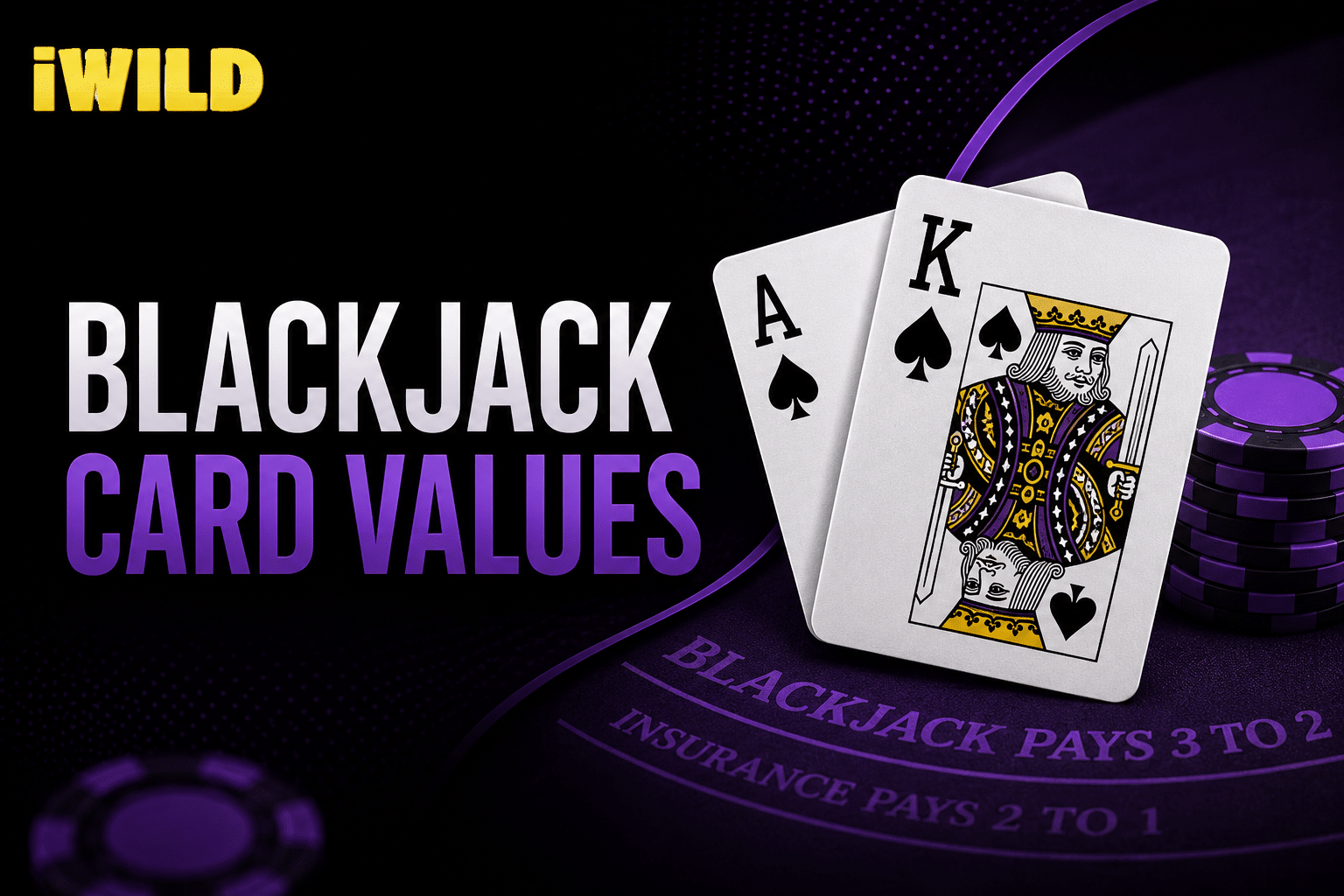
Blackjack card values are simple once you see how they work: number cards match their printed value, face cards are all worth 10, and the ace can be either 1 or 11. That’s the entire scoring system.
This iWild Casino guide gives you a clear reference for every Blackjack card, explains soft versus hard hands, and shows how these values shape your decisions so you can play smarter at the table.
Blackjack Card Value Chart
This chart is your quick-reference for Blackjack card values, designed so you can scan it in seconds during play. It shows exactly what each card is worth without any guesswork.
Every card has a fixed value except the Ace, which can be 1 or 11 depending on your hand. We’ll explain how that works in more detail further down the page.
|
Card |
Value in Blackjack |
|
Ace |
1 or 11 |
|
2 |
2 |
|
3 |
3 |
|
4 |
4 |
|
5 |
5 |
|
6 |
6 |
|
7 |
7 |
|
8 |
8 |
|
9 |
9 |
|
10 |
10 |
|
Jack |
10 |
|
Queen |
10 |
|
King |
10 |
What Is a Blackjack Hand?
A Blackjack hand, also called a natural, is a two-card hand made up of an Ace and any 10-value card (10, Jack, Queen, or King), giving you a total of 21. It’s the best possible start in the game.
This hand usually wins automatically and often pays higher than standard wins. The only exception is when the dealer also has Blackjack, which results in a push, meaning you keep your original bet.
Why Card Values Matter in Blackjack
Every decision in Blackjack—hit, stand, double, or split—comes down to your current hand total. Card values are what define that total, so they directly guide every move you make at the table.
If you miscalculate your hand, your decision will be off, no matter how well you understand strategy. Getting the values right is the foundation everything else in Blackjack is built on.
How to Calculate Your Hand Value
Calculating your hand in Blackjack is simple: just add the value of each card together to get your total. That number is what you’ll use to decide your next move.
The only exception is the Ace, which can count as 1 or 11 depending on what helps your hand most. We’ll break that down clearly in the next section with examples.
Worked Example Hands
These examples show exactly how Blackjack card values are added in real hands. Scan them to see how totals are built step by step, including how the Ace can change your final number.
|
Hand |
Calculation |
Total |
|
8 and 7 |
8 + 7 |
15 |
|
5 and 6 and 3 |
5 + 6 + 3 |
14 |
|
King and Queen |
10 + 10 |
20 |
|
Ace and 6 |
11 + 6 or 1 + 6 |
17 or 7 |
|
Ace and Ace |
11 + 1 or 1 + 1 |
12 or 2 |
Understanding the Ace — The Most Flexible Card
The Ace is the only Blackjack card with a variable value, counting as either 1 or 11. This flexibility exists to help you avoid an instant bust while still aiming for a strong total.
The sections below show how this works in practice, depending on whether your hand is soft or hard.
The Value of an Ace in a Soft Hand
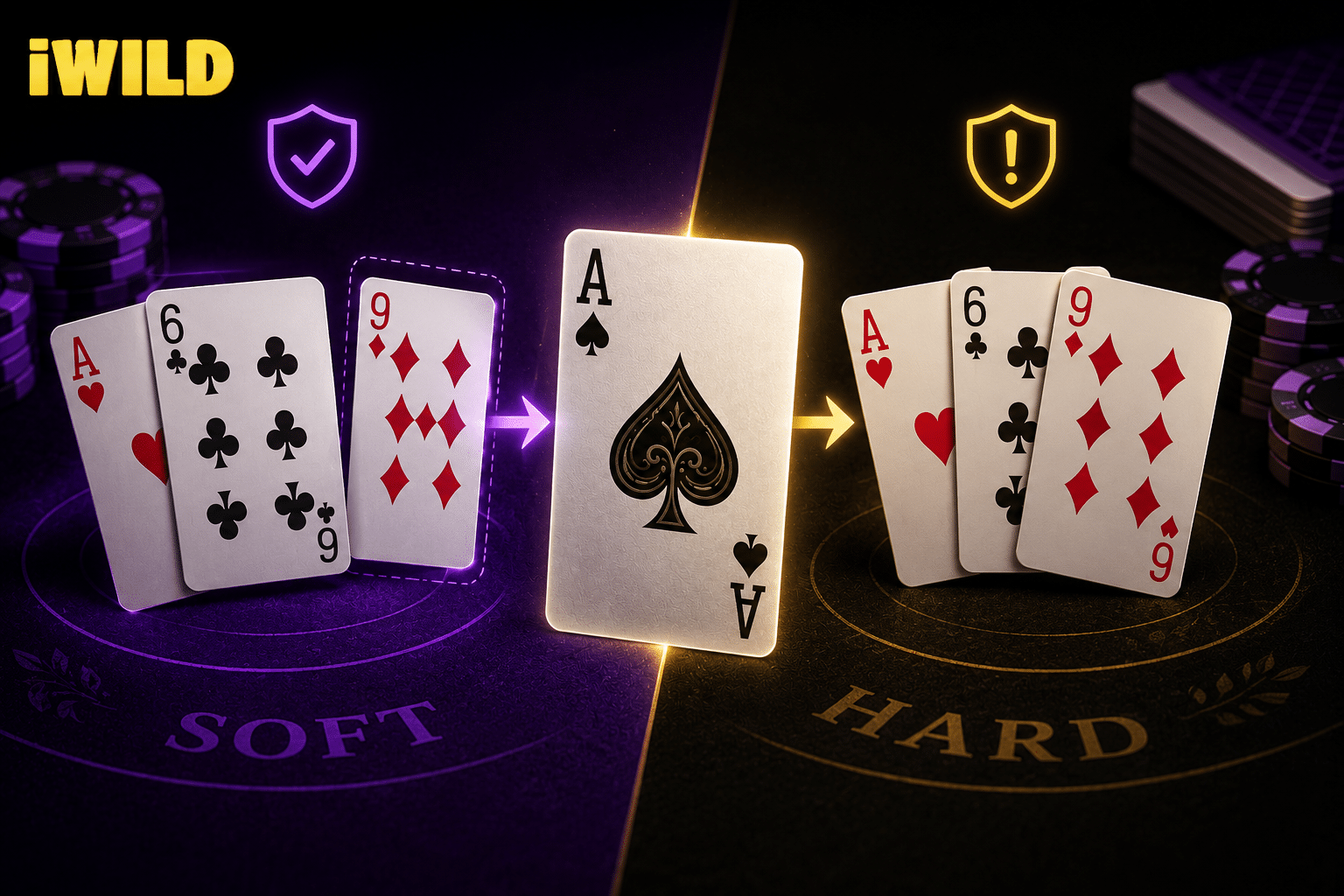
A soft hand includes an Ace counted as 11 without risking a bust. This gives you flexibility, because you can draw another card and adjust if needed.
For example, you start with Ace + 5 = 16 (soft). You draw a 4, making it 20, still soft. If you then draw a 10, the Ace switches to 1, giving you 20 instead of busting.
This is why soft hands are safer to play aggressively.
The Value of an Ace in a Hard Hand
A hard hand has no Ace, or the Ace must count as 1 to avoid busting. This removes the flexibility and increases risk with every new card.
For example, you start with Ace + 6 = 17 (soft). You draw a 10, which would make 27, so the Ace becomes 1, giving you 17. Now it’s a hard hand.
At this point, any additional card could bust your hand, so decisions must be more cautious.
Soft Hands vs Hard Hands — Why the Difference Matters
The key difference between soft and hard hands is risk. A soft hand can be hit safely since you can’t bust on the next card, while a hard hand carries a real chance of going over 21.
This is why the same total, like 17, plays differently depending on the hand type.
|
Hand Type |
Description |
Example |
Why It Matters |
|
Soft Hand |
Contains an Ace counted as 11 |
Ace + 6 (soft 17) |
Can hit without immediate bust risk |
|
Hard Hand |
No Ace, or Ace counted as 1 |
10 + 7 (hard 17) |
Higher risk when taking another card |
Number Cards, Face Cards, and Their Values
This section breaks down number and face card values in plain terms, separate from the Ace. These cards are straightforward because their values never change, making them the easiest part of Blackjack to understand.
Number Cards (2 to 10)
Every number card from 2 through 10 is worth exactly what’s printed on it. A 7 is always 7, a 3 is always 3, with no exceptions.
This is the simplest part of Blackjack card values and rarely causes confusion.
Face Cards (King, Queen, Jack)
All face cards—King, Queen, and Jack—are worth 10 points each. Their suit or design doesn’t affect their value in any way.
Because of this, they’re often grouped together as “10-value cards” in Blackjack strategy.
The Objective of Blackjack
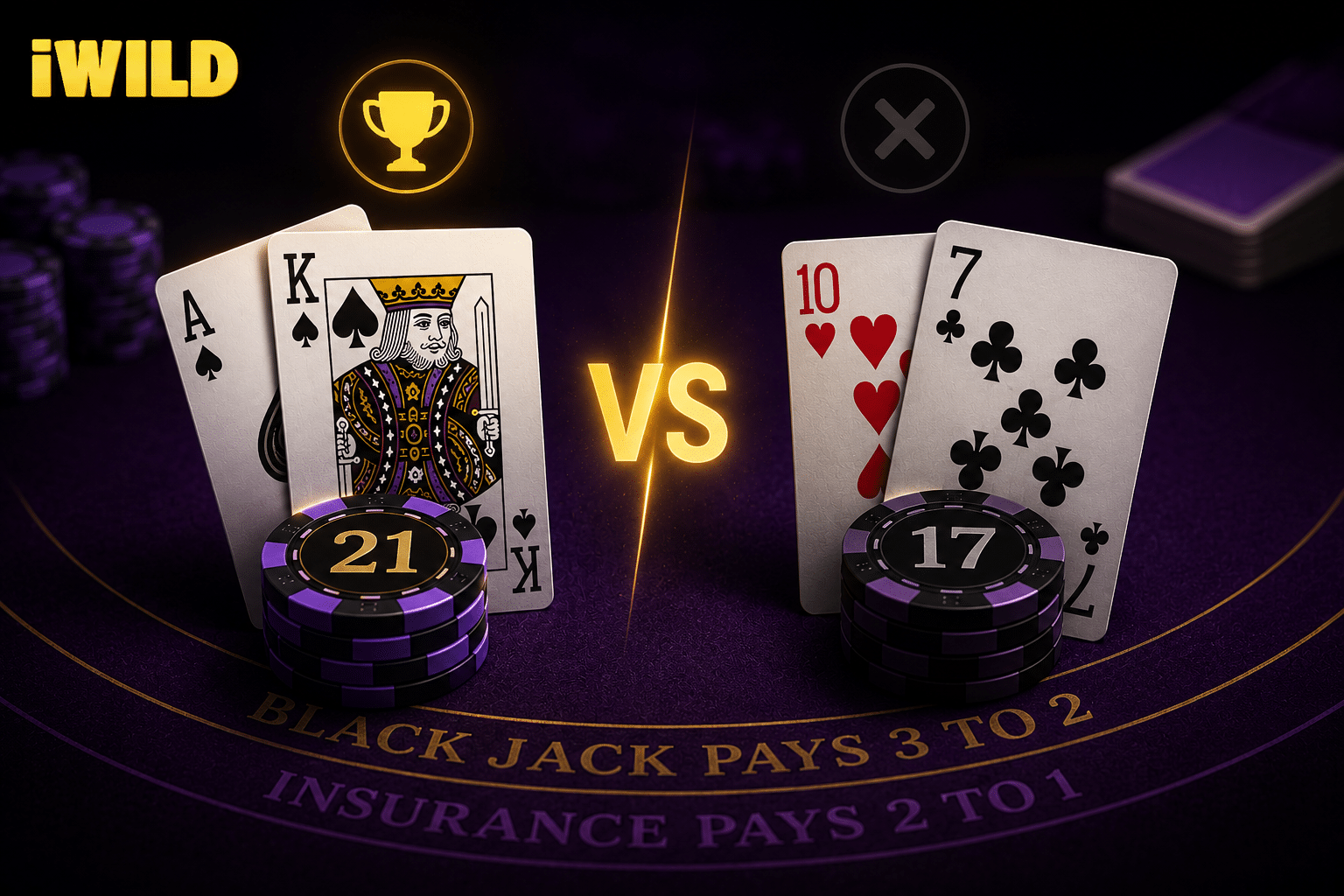
All Blackjack card values serve one clear goal: build a hand as close to 21 as possible without going over, and finish with a higher total than the dealer.
The sections below break down each part of that objective so you can see how it plays out in real hands.
Reaching 21 Without Going Bust
Busting happens when your hand goes over 21, and it results in an instant loss, no matter what the dealer ends up with. That’s why every point matters.
Accurate hand calculation isn’t optional. Misreading your total can lead to hitting when you shouldn’t, or standing when you still have a safe move available.
Beating the Dealer’s Hand
Getting close to 21 is only half the job—you also need to beat the dealer’s final hand. Your total must be higher without going over.
You win in three ways: your hand beats the dealer’s, the dealer busts while you don’t, or you have a natural Blackjack that the dealer doesn’t match.
How Card Values Shape Your Strategy
Everything in Blackjack strategy comes back to card values. Basic strategy, the standard set of recommended plays, is built entirely on your hand total and the dealer’s visible up-card.
The sections below turn those values into practical rules you can actually use at the table.
Quick Strategy Rules by Hand Value
Basic strategy is built on your hand total and the dealer’s up-card. For totals between 12 and 16, stand when the dealer shows 2–6, and hit when they show 7 or higher.
Hard 17 is a clear stand, while soft 17 can often be hit because the Ace keeps the hand flexible. Always split Aces and 8s, and never split 5s or 10s.
These are core rules to get you started—use a full strategy guide for complete decision-making.
Playing a Stiff Hand (12 to 16)
A stiff hand is any total from 12 to 16, where hitting risks a bust, but standing may still lose. It’s one of the toughest spots in Blackjack.
The dealer’s up-card decides your move. Against weak cards (2–6), you usually stand. Against strong cards, you often hit despite the risk.
What Double After Split (DAS) Means for Your Value Decisions
Double After Split (DAS) is a rule that lets you double down on hands created after splitting a pair, as long as the new hand qualifies.
This makes splitting more valuable, since you can turn strong follow-up hands into bigger wins. Without DAS, some splits become less attractive.
Should You Split a Pair of 9s?
Splitting 9s isn’t automatic—it depends on the dealer’s up-card. Against weaker cards (2–6), splitting is usually the better play.
Against stronger cards, it’s often better to keep the total of 18. This shows how card values alone aren’t enough—you always need to factor in the dealer’s hand.
Common Card Value Mistakes to Avoid
Most Blackjack calculation errors come from a few repeat mistakes, not confusion about the rules. These small slips can lead to poor decisions and unnecessary losses.
The sections below cover the two most common issues and how to avoid them.
Misjudging the Value of an Ace
The most common mistake is keeping an Ace valued at 11 when it should switch to 1. This can make a safe hand look like a bust.
For example, Ace + 7 = 18. If you draw a 9, counting the Ace as 11 gives 27, but it should switch to 1, making the total 17.
Errors When Adding Up Your Total
Simple addition mistakes often happen in multi-card hands, especially after several hits. Losing track of your running total can lead to the wrong move.
A better habit is to recalculate the full hand each time. This avoids carrying forward a small error that could affect the entire decision.
How Card Counting Uses These Same Values
Card counting builds on Blackjack card values, but it doesn’t use them directly. Instead, it assigns simplified points like +1, 0, or -1 to track whether more high or low cards remain in the deck.
This is where confusion often happens—counting values are not the same as playing values. You still rely on standard card values to make decisions at the table.
Understanding those core values first is essential, because card counting only makes sense once that foundation is solid.
Frequently asked questions
The Ace is worth either 1 or 11 in Blackjack. It automatically takes the value that benefits your hand most without causing a bust, making it the most flexible card in the game.
Face cards are all worth 10 in Blackjack. This includes the King, Queen, and Jack, and their value does not change based on suit or design.
A soft 17 is a hand totaling 17 that includes an Ace counted as 11. For example, Ace + 6 equals 17 and remains flexible if you draw another card.
A soft hand cannot bust on the very next card. If a draw would push the total over 21, the Ace simply switches from 11 to 1 to keep the hand alive.
The highest hand value in Blackjack is 21. The strongest way to reach it is with a natural Blackjack, made from an Ace and any 10-value card.
Card values do not change in online Blackjack. They are fixed rules of the game, so whether you play online or in person, the values always stay the same.

