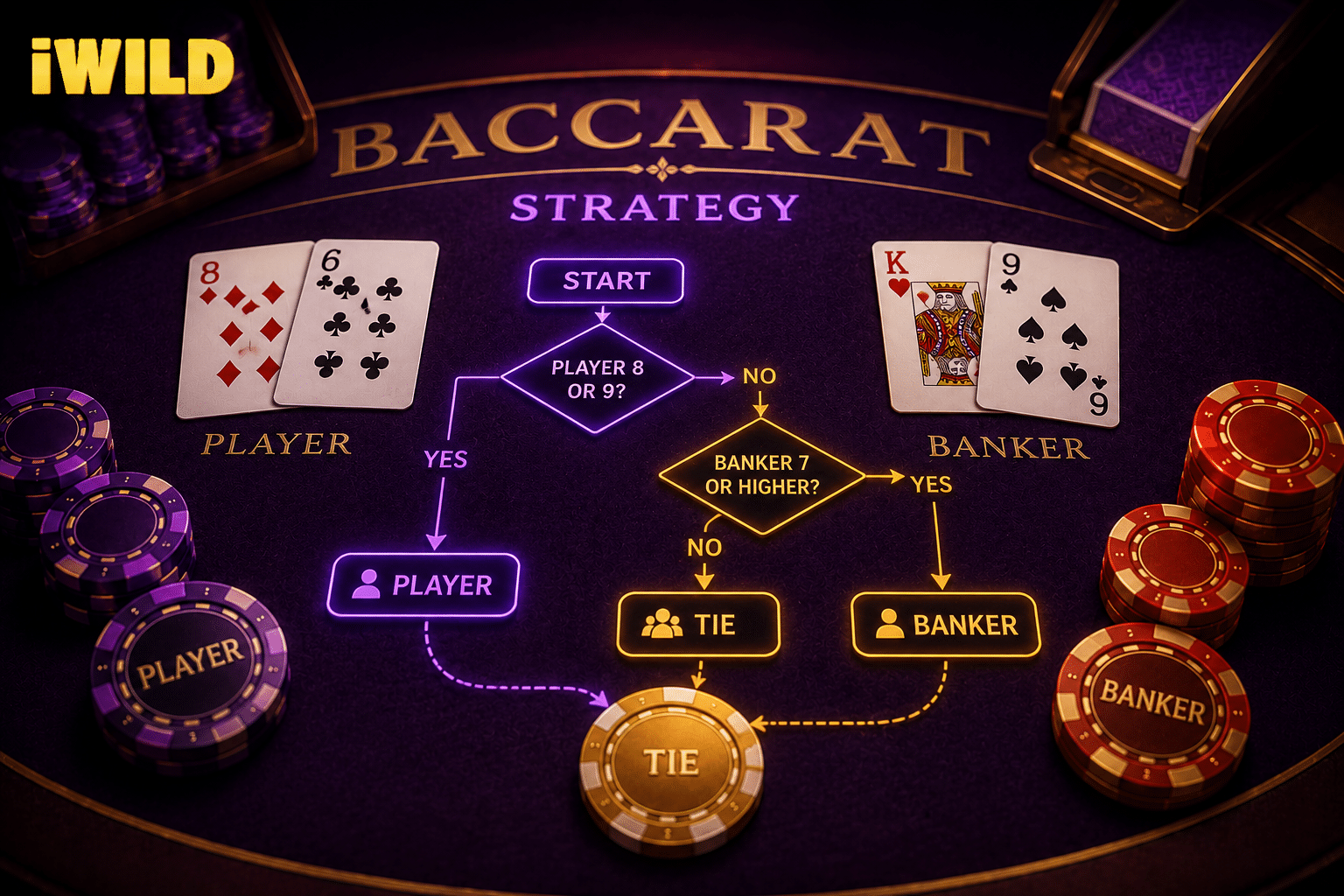
Baccarat strategy starts with understanding the real odds behind every bet and how they shape your results over time. This guide breaks down what actually matters so you can make smarter, calmer decisions at the table.
With iWild’s guide you’ll learn which bets carry the lowest risk, how popular systems really work, and why bankroll control matters more than any pattern or streak.
No system can change the house edge, but informed choices can help you play longer and lose less.
Understanding the Basics of Baccarat
Baccarat is a casino game played between two hands—the Player and the Banker—and you bet on which one will finish closest to a total of 9, or if the round will end in a tie. The goal is simple, but the scoring system is what makes the game unique.
Card values are easy to learn:
- Cards 2–9 are worth their face value
- 10s and face cards are worth 0
- Aces are worth 1
Only the last digit of the total counts, so a hand of 15 becomes 5.
A third card may be drawn based on fixed rules, not player choice. That’s why baccarat has no decisions after your bet is placed.
Player vs Banker vs Tie — The Core Bets
Every baccarat round gives you three betting options: Player, Banker, or Tie. The game itself has no decisions after the bet, so your strategy lives entirely in choosing which outcome to back.
Below is how each bet actually performs in real mathematical terms.
Banker Bet
The Banker bet is the strongest option statistically, with a win probability of about 45.86% and a house edge of 1.06%. It wins slightly more often due to the game’s drawing rules.
A 5% commission is charged on winning Banker bets, but this is already included in the 1.06% edge. It’s not an extra cost on top.
This is why experienced baccarat players and mathematicians consistently favor the Banker bet.
Player Bet
The Player bet is the second-best option, with a win probability of around 44.62% and a house edge of 1.24%. It performs very close to the Banker bet but falls just behind.
There’s no commission on Player wins, which makes it appealing for simplicity. Still, the math slightly favors the Banker overall.
It’s a reasonable choice if you prefer to avoid commission and accept a small increase in house edge.
Tie Bet Considerations
The Tie bet looks attractive because of its high payout, but it’s statistically weak. It wins only about 9.52% of the time, making it far less reliable than the other options.
At an 8:1 payout, the house edge is around 14.36%. Some tables offer 9:1, which lowers the edge to about 4.85%, but it’s still much higher than Player or Banker.
Always check the payout before placing this bet. Even then, most professional advice recommends avoiding Tie bets as part of any serious baccarat strategy.
Baccarat Variants Worth Knowing
While baccarat has several historical versions, only a few are commonly seen today. In modern casinos and online platforms, three variants are genuinely relevant for most players.
Here’s what you actually need to know about each one.

Punto Banco
Punto Banco is the standard version of baccarat and the one you’ll find at most online casinos. The rules are fully automated, and the casino always acts as the banker.
You don’t make decisions during play—only which bet to place. When people say “baccarat,” this is almost always the version they mean.
Mini Baccarat
Mini Baccarat uses the same rules as Punto Banco but is designed for speed and accessibility. The table is smaller, and the minimum bets are much lower.
More hands are dealt per hour, making it ideal for online play and casual sessions where you want faster action with smaller stakes.
Chemin de Fer
Chemin de Fer is the traditional French version where players can choose whether to draw a third card and take turns acting as the banker.
This adds a small element of skill, unlike Punto Banco. It’s historically famous, especially from James Bond, but rarely available online or in modern casinos.
Why Strategy Matters in Baccarat
Baccarat has no in-game decisions after you place your bet, so strategy isn’t about influencing the cards. Instead, it’s entirely about choosing the right bets and managing your bankroll effectively.
Understanding the real odds behind each option helps you avoid costly mistakes, especially with high-edge bets like Tie.
Consistent bankroll discipline keeps your sessions controlled and sustainable. That’s the full scope of baccarat strategy—and it still makes a meaningful difference.
Baccarat Betting Strategies
Baccarat strategies fall into two simple categories: bet selection and betting systems. Bet selection is about choosing the lowest-risk option, while systems focus on how you size your bets over time.
Betting systems can add structure and help control your bankroll, but they don’t change the house edge on any individual bet.

Bet on the Banker — Understanding the Advantage
The Banker bet is the single most mathematically sound baccarat strategy available. It consistently offers the lowest house edge, making it the best default choice for long-term play.
This advantage comes from the game’s fixed drawing rules. The Banker hand acts after the Player, giving it a structural edge in third-card scenarios and close outcomes.
This isn’t theory—it holds up across simulations and real gameplay data. No other decision in baccarat is as strongly supported by the math as consistently betting on the Banker.
Why Many Players Avoid the Tie Bet
The Tie bet is widely avoided because its house edge is dramatically higher than the alternatives. At standard 8:1 payouts, it’s more than ten times worse than Banker or Player.
Placing it occasionally isn’t disastrous on its own, but building any strategy around it is mathematically unsound. The risk simply outweighs the reward over time.
The Martingale System
The Martingale system works by doubling your bet after every loss, then resetting to your base bet after a win. The idea is that one win recovers all previous losses plus a small profit.
Example:
- Bet $10 → lose
- Bet $20 → lose
- Bet $40 → win → recover losses + $10 profit
The problem is risk. Table limits can stop progression, and losing streaks can drain your bankroll quickly. It feels logical, but it doesn’t change the house edge.
The Paroli System
The Paroli system flips Martingale by increasing bets after wins instead of losses. Players usually double after each win and reset after three consecutive wins or a single loss.
Example:
- Bet $10 → win
- Bet $20 → win
- Bet $40 → win → reset
This approach is lower risk since you’re using winnings, not chasing losses. Still, it doesn’t improve the underlying odds.
The Fibonacci System
The Fibonacci system follows a sequence where each number is the sum of the two before it. You move one step forward after a loss and two steps back after a win.
Example:
- Bet 1 → lose
- Bet 1 → lose
- Bet 2 → win → move back to 1
This creates a slower progression than Martingale, reducing the speed of losses. Still, it doesn’t change the house edge on any bet.
The Labouchere Method
The Labouchere method starts by writing a sequence of numbers that represent your target profit. You bet the sum of the first and last numbers in the sequence.
After a win, you cross off those numbers. After a loss, you add the lost amount to the end of the sequence. You continue until all numbers are cleared.
It allows for structured profit goals but requires careful tracking and is more complex than most systems.
The D’Alembert System
The D’Alembert system increases your bet by one unit after a loss and decreases it by one unit after a win. It’s a gentler alternative to Martingale.
This creates a slower, more controlled progression that suits longer sessions and smaller bankrolls.
However, like all systems, it doesn’t provide any mathematical advantage over flat betting.
The 1-3-2-4 System
The 1-3-2-4 system uses a fixed sequence of bets: 1 unit, then 3, then 2, then 4. You only move to the next step after a win, and reset to 1 after any loss.
Example:
- Bet 1 → win
- Bet 3 → win
- Bet 2 → win
- Bet 4 → win → reset
If you lose at any stage, you return to the start. This structure locks in partial profit during winning streaks instead of risking everything.
It’s a more balanced approach than aggressive systems, offering lower risk while still depending on wins to generate profit.
Flat Betting Strategy
Flat betting is the simplest approach: you wager the same fixed amount on every hand, no matter the outcome. There’s no progression, no adjustment, and no escalation.
This removes emotional decision-making and avoids the risk of bets growing out of control during losing streaks.
It’s the most bankroll-friendly option here, ideal for longer sessions or for players who prefer a clean, low-stress way to track results.
Return to Player and Betting Odds
The key baccarat numbers are straightforward: the Banker bet has a 1.06% house edge, the Player bet 1.24%, and the Tie bet 14.36% at 8:1 or about 4.85% at 9:1. These figures define every betting decision.
In practice, this means the percentage of each wager you can expect to lose over many hands—not what happens in a single session.
Even the Player bet, while slightly worse than Banker, still offers one of the lowest house edges in the casino.
| Bet Type | Win Probability | House Edge | Commission |
| Banker | ~45.86% | 1.06% | 5% on wins |
| Player | ~44.62% | 1.24% | None |
| Tie (8:1 payout) | ~9.52% | 14.36% | None |
| Tie (9:1 payout) | ~9.52% | ~4.85% | None |
Bankroll and Game Management
Good baccarat play starts with clear bankroll rules. A practical guideline is to bet no more than 2–5% of your total session bankroll on a single hand, keeping swings manageable.
Bring enough units to handle normal variance, rather than risking your entire bankroll in a few rounds. Short bankrolls increase the chance of quick losses.
Set a firm loss limit and a realistic win goal before you start, then stick to both. No betting system replaces this discipline, and most long-term losses come from abandoning it under pressure.
Online vs Land-Based Baccarat
Online baccarat and land-based baccarat feel quite different in how you play, even though the rules and odds are identical. The choice comes down to convenience, pace, and atmosphere rather than strategy.
Here’s how they differ in practice:
Online baccarat
- Lower minimum bets, often starting very small
- Multiple variants and speeds available instantly
- Faster gameplay, especially with RNG tables
- Play anytime, anywhere
Land-based baccarat
- Higher minimum bets at most tables
- Limited table availability and variants
- Slower pace with more social interaction
- Physical casino atmosphere and experience
Both versions use the same math, so neither offers a strategic edge. It’s simply about how you prefer to play.
Common Mistakes to Avoid
Most losses beyond the normal house edge don’t come from bad luck. They come from a few repeatable mistakes that are easy to avoid once you understand them.
The two below are the biggest ones.
Misunderstanding Odds and House Edge
Many players overvalue the Tie bet because of its high payout, ignoring its much higher house edge. It looks appealing, but the math works strongly against it.
Another common mistake is assuming the Banker commission makes the Player bet better. It doesn’t—the Banker still has the lower overall house edge.
Finally, no hand is ever “due.” Baccarat results are independent, so past outcomes have no effect on what happens next.
Overbetting and Poor Bankroll Discipline
Chasing losses is one of the fastest ways to lose control. Increasing your bet beyond your system or limits can quickly drain your bankroll.
Playing with too little money also creates problems, as normal variance can wipe you out before your strategy has any chance to play out.
Staying longer than planned—whether chasing losses or riding wins—breaks discipline. No system can protect against poor bankroll decisions.
Practising and Improving Your Play
The best way to get comfortable with baccarat is to practise before using real money. Free-play or demo versions let you learn the pace, rules, and flow without risk.
You can also test a betting system on paper or in a simple spreadsheet. Run it through both winning and losing streaks to see how it behaves.
This kind of practice builds confidence and helps you avoid surprises when real money is on the table.
Reviewing Past Sessions to Spot Patterns in Your Own Play
Looking back at your past sessions isn’t about finding patterns in the game—there aren’t any to find. It’s about spotting patterns in your own behavior.
Check if losses lead to bigger bets outside your system, or if sessions run longer than planned. Compare your results to what your strategy would realistically produce.
This is about self-awareness, not predicting outcomes, and it’s one of the most useful habits a baccarat player can build.
Why Baccarat Systems Can’t Beat the House Edge — The Math Explained
Baccarat systems can’t beat the house edge because every single bet carries the same fixed probability, no matter what happened before. Each hand is an independent event, so past results, bet size, or system choice don’t change the odds.
The house edge is built into every wager. Whether you’re betting small, doubling after losses, or following a sequence, the percentage the casino expects to keep stays the same.
Systems only change how results appear. They affect the timing and size of wins and losses—how quickly they come, how large they are, and how they cluster—but not the long-term outcome.
For example, doubling your bet after a loss doesn’t make the next hand more likely to win. It only increases what you stand to gain or lose on that one hand.
Even advanced ideas like card counting barely apply. In baccarat, it offers only about a 0.05–0.07% theoretical edge, which is too small to overcome the game’s structure in practice.
Frequently asked questions
The best baccarat strategy is to consistently bet on the Banker. It offers the lowest house edge, making it the most efficient long-term choice.
Combine this with disciplined bankroll management to control risk and extend your playing time.
No, betting systems cannot help you win in the long run. They don’t change the house edge on any individual bet.
What they do provide is structure, helping manage variance and organize how you place your bets.
No, card counting is not effective in baccarat. The theoretical edge is only around 0.05–0.07%.
This is far too small to be practical, especially compared to games like blackjack where it can matter.
Players avoid the Tie bet because it has a much higher house edge. Despite the appealing payout, it’s statistically weak.
Over time, it costs significantly more than betting on Banker or Player.
Baccarat is a game of luck when it comes to outcomes. In Punto Banco, there are no decisions after placing your bet.
Skill only applies to choosing better bets and managing your bankroll effectively.
No, you cannot win consistently over the long term. The house edge makes sustained profit mathematically unlikely.
Short-term wins happen often, but they come from variance rather than a reliable strategy.

